
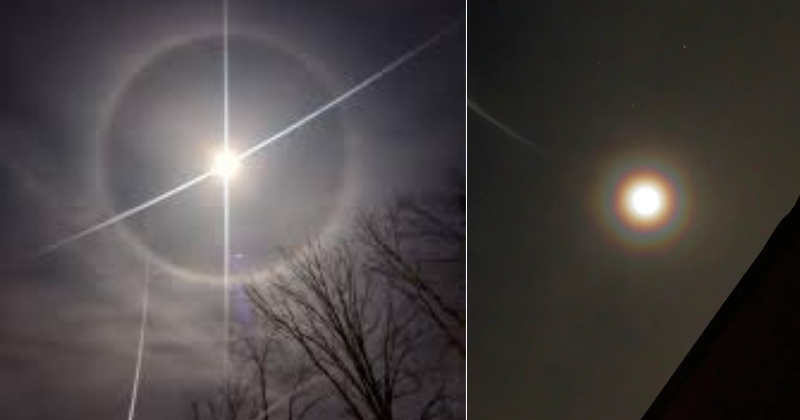
On October 25, 2025, observers across various latitudes will have the opportunity to witness a halo moon—a striking atmospheric optical phenomenon where a luminous ring encircles the lunar disk. This celestial spectacle results from the refraction of moonlight through ice crystals suspended in cirrostratus clouds at altitudes between 5,000 and 10,000 meters, creating a characteristic 22-degree radius circle that has captivated astronomers and atmospheric scientists for centuries.
The Physical Mechanisms of Lunar Halos
The formation of a moon halo requires specific atmospheric conditions and precise geometric arrangements. When moonlight encounters hexagonal ice crystals in the upper troposphere, the light undergoes refraction at an angle of approximately 22 degrees as it passes through the crystal structure. This angle derives from the internal geometry of ice crystals, which typically form as hexagonal prisms with 60-degree angles between their faces.
The refraction process involves the bending of light as it transitions between media of different densities—from air into ice and back into air. The minimum deviation angle for light passing through a hexagonal ice crystal occurs at 21.8 degrees, which explains the consistent radius observed in most lunar halos. Unlike lunar eclipses or planetary transits, halos depend entirely on Earth’s atmospheric composition and the distribution of ice crystals at high altitudes.
Atmospheric Prerequisites for Halo Formation
Cirrostratus clouds serve as the primary medium for halo generation. These high-altitude clouds consist predominantly of ice crystals rather than water droplets, distinguishing them from lower-altitude cloud formations. The crystals must be randomly oriented in three-dimensional space to produce a complete circular halo. When ice crystals align preferentially due to aerodynamic forces, observers may witness partial arcs or modified halo structures.
The optical depth of cirrostratus layers influences halo visibility. Thin, translucent cloud coverage allows sufficient moonlight transmission while maintaining adequate crystal density for refraction. Excessively thick clouds obscure the moon entirely, while completely clear skies eliminate the crystalline medium necessary for halo formation. Temperature profiles at altitudes above 6,000 meters must remain below -20°C to ensure ice crystal stability rather than supercooled water droplets.
Observational Characteristics and Variations
The classic 22-degree halo appears as a bright ring with a reddish inner edge and a bluish outer boundary. This chromatic separation results from wavelength-dependent refraction, similar to the dispersion observed in prisms. Red light, with its longer wavelength, refracts at slightly smaller angles than blue light, creating the characteristic color gradient. The intensity distribution within the halo varies, with maximum brightness occurring at the inner edge due to the concentration of minimally deviated light rays.
Some observers report additional optical features accompanying the primary halo. Tangent arcs may appear at the top and bottom of the circle when ice crystals adopt specific orientations. In rare instances, a secondary halo with a 46-degree radius forms through light passing through alternate crystal faces, though this phenomenon requires exceptionally uniform crystal populations and remains less frequently observed than the primary ring.
Historical Documentation and Cultural Interpretations
Astronomical records from ancient civilizations document lunar halos with varying degrees of scientific understanding. Chinese astronomers during the Han Dynasty catalogued these phenomena as atmospheric omens, while European scholars in the medieval period debated their meteorological significance. The first quantitative explanation emerged in 1665 when René Descartes proposed ice crystal refraction as the underlying mechanism, later refined by Christiaan Huygens through mathematical analysis of crystal geometry.
Indigenous cultures across multiple continents incorporated lunar halos into predictive meteorological frameworks. Many societies recognized the correlation between cirrostratus clouds and approaching weather systems, using halo observations to anticipate precipitation within 24 to 48 hours. This empirical knowledge reflected accurate observations of atmospheric dynamics, as cirrostratus often precedes warm fronts associated with moisture-laden air masses.
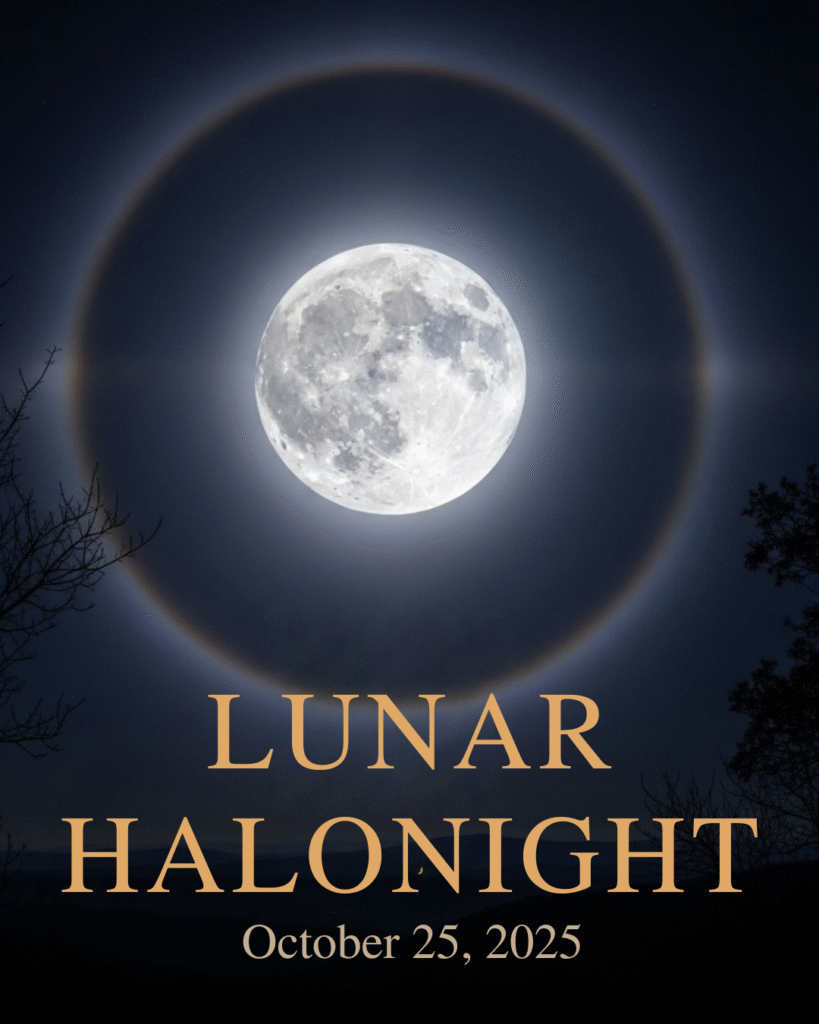
Photographic Documentation Techniques
Capturing lunar halos presents technical challenges due to the significant brightness differential between the moon and the surrounding halo. Modern digital sensors excel at recording this phenomenon when photographers employ specific exposure strategies. A baseline approach involves metering for the moon itself, then increasing exposure by 1 to 2 stops to render the fainter halo structure visible without completely overexposing the lunar disk.
Wide-angle lenses between 14mm and 35mm (full-frame equivalent) provide adequate field coverage to encompass the entire 44-degree diameter of the halo while including foreground elements for compositional context. Tripod stabilization becomes essential for exposures exceeding 1 second, though the moon’s motion across the celestial sphere remains negligible for exposures under 5 seconds at wide focal lengths. ISO settings between 800 and 3200 typically balance noise control with adequate sensitivity for halo detection.
Meteorological Implications and Weather Forecasting
The appearance of lunar halos functions as a reliable indicator of atmospheric conditions at multiple altitudes. Cirrostratus formation typically signals the approach of a warm front, where less dense warm air overrides cooler surface air masses. This configuration produces gradual cloud thickening at progressively lower altitudes as the front advances, often culminating in precipitation within 12 to 36 hours.
Meteorologists utilize satellite imagery and radiosonde data to correlate halo observations with synoptic-scale weather patterns. The presence of ice-crystal clouds at 7,000 to 9,000 meters indicates sufficient moisture content and cooling at those altitudes, parameters that numerical weather prediction models incorporate when generating precipitation forecasts. While halos themselves don’t cause weather changes, they serve as visible manifestations of atmospheric processes already underway.
Distinguishing Halos from Corona Effects
Observers sometimes confuse lunar halos with coronas, a distinct optical phenomenon producing smaller, colorful rings immediately adjacent to the moon. Coronas result from diffraction rather than refraction, occurring when moonlight interacts with water droplets or small ice particles in thin clouds. The angular size of coronas rarely exceeds 5 degrees and exhibits multiple concentric rings with alternating colors, contrasting sharply with the single, larger 22-degree halo.
The physical scale of the scattering particles determines which phenomenon manifests. Particles measuring 10 to 50 micrometers produce corona effects through wave interference, while the much larger ice crystals responsible for halos—typically 100 micrometers or more—operate through geometric optics and refraction. Mixed cloud conditions occasionally produce both phenomena simultaneously, though the distinctly different angular scales prevent visual overlap.
Observation Conditions for October 25, 2025
The specific date of October 25, 2025, corresponds to a waning crescent moon phase, with the lunar disk illuminated at approximately 15 percent. This reduced brightness compared to full moon conditions may render halo observation more challenging in light-polluted environments, though it simultaneously reduces the risk of overexposure in photographic applications. Observers in rural locations with minimal artificial illumination will experience optimal viewing conditions.
Geographical latitude influences observation probability through its effect on typical weather patterns and jet stream positioning during late October. Mid-latitude regions between 30 and 50 degrees north or south commonly experience transitional weather systems during autumn months, increasing the likelihood of cirrostratus cloud coverage. Tropical latitudes rarely develop the high-altitude ice-crystal clouds necessary for halo formation, while polar regions may experience continuous cloud coverage that obscures lunar visibility entirely.
Scientific Research Applications
Contemporary atmospheric scientists employ halo observations as validation data for remote sensing instruments and radiative transfer models. Satellite-based lidar systems detect ice crystal distributions at various altitudes, but ground-based visual confirmations through halo sightings provide independent verification of cloud composition and particle orientation. This dual-method approach enhances confidence in atmospheric models used for climate research and aviation safety applications.
The microphysical properties of ice crystals influence their optical behavior beyond simple refraction angles. Crystal habit—whether columnar, plate-like, or irregularly shaped—affects light scattering patterns and contributes to halo brightness variations. Research programs investigating cirrus cloud formation mechanisms utilize halo statistics as proxy indicators of crystal growth conditions, linking observable optical phenomena to thermodynamic processes occurring at inaccessible altitudes.
Optimizing Observation Strategies
Successful halo observation requires attention to both timing and location selection. The phenomenon remains visible throughout the night provided cirrostratus coverage persists, though observers should prioritize periods when the moon reaches higher elevation angles above 30 degrees. Lower lunar positions increase atmospheric path length and associated extinction, diminishing both moon and halo brightness through enhanced scattering and absorption.
Urban observers face challenges from light pollution, which reduces contrast between the halo and background sky. Positioning oneself to block direct views of streetlights and building illumination significantly improves detection capability. Dark adaptation of the human eye, achieved through 10 to 15 minutes of avoiding bright light sources, enhances sensitivity to the subtle brightness variations characteristic of lunar halos. Some observers report improved detection when viewing the halo peripherally rather than through direct gaze, exploiting the rod-dominated regions of the retina with enhanced low-light sensitivity.
Comparative Planetary Phenomena
While lunar halos dominate Earth-based observations, analogous phenomena occur on other planets with appropriate atmospheric compositions. Mars occasionally exhibits halos around its two small moons, Phobos and Deimos, when rare ice-crystal clouds form in its tenuous atmosphere during winter conditions. The requisite crystal structure depends on carbon dioxide ice rather than water ice, potentially producing different characteristic angles based on the distinct molecular geometry of CO₂ crystals.
Jupiter’s moon Europa, with its proposed subsurface ocean and potential ice-particle geysers, might produce transient halo-like effects under specific illumination geometries, though no spacecraft observations have yet documented such phenomena. Theoretical models suggest that ice particles ejected from Europa’s surface could create temporary optical displays visible to hypothetical observers positioned on that moon’s surface, though the mechanisms would differ substantially from Earth’s atmospheric halos due to the absence of a dense gaseous medium.
The October 25, 2025 halo moon night offers observers a tangible connection to atmospheric physics operating continuously overhead. This intersection of optical principles, crystallography, and meteorology manifests as an accessible celestial display requiring only clear sight lines and appropriate cloud conditions. Whether documented photographically or simply appreciated visually, lunar halos represent one of nature’s most elegant demonstrations of light’s interaction with structured matter suspended in Earth’s upper atmosphere.