
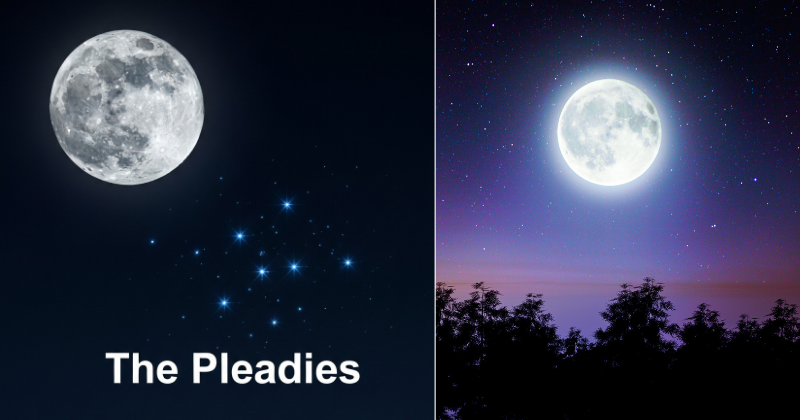
Tonight offers a remarkable astronomical convergence as the Moon passes through the Pleiades star cluster, creating a celestial alignment visible to observers across the Northern Hemisphere. This conjunction in the constellation Taurus presents an exceptional opportunity for both amateur and experienced astronomers to witness one of nature’s most photogenic cosmic arrangements.
Understanding the Pleiades: More Than Seven Sisters
The Pleiades, catalogued as Messier 45 (M45), represents an open star cluster located approximately 444 light-years from Earth within the constellation Taurus. Despite the popular designation as the « Seven Sisters » derived from Greek mythology, this cluster contains over 1,000 confirmed stellar members, though only six to nine stars typically remain visible to the unaided eye under normal viewing conditions.
The brightest members of the cluster—Alcyone, Atlas, Electra, Maia, Merope, Taygeta, Pleione, Celaeno, and Asterope—formed approximately 100 million years ago from the same molecular cloud, making them stellar siblings in the astronomical sense. Their characteristic blue-white luminosity results from their classification as B-type main-sequence stars, burning hotter and brighter than our Sun. The nebulosity often captured in long-exposure photographs represents reflection nebulae, where interstellar dust particles scatter the starlight, creating ethereal blue wisps that the cluster traverses during its journey through the galactic plane.
Orbital Mechanics Behind Tonight’s Conjunction
The Moon’s apparent path across the celestial sphere, known as its ecliptic, intersects the Pleiades region approximately once every 27.3 days during its sidereal orbital period. However, the visual prominence of these conjunctions varies significantly based on the Moon’s phase, atmospheric conditions, and the precise angular separation between the lunar disk and the cluster’s core.
Tonight’s event occurs under particularly favorable circumstances. The Moon’s illumination phase provides sufficient brightness to frame the cluster without overwhelming the fainter stellar members through excessive glare. The angular separation allows observers to simultaneously appreciate the lunar surface features and the Pleiades configuration within a single telescope field of view, creating what astronomers term a « photogenic conjunction. » The Moon will pass through the cluster over several hours, with the closest approach varying by geographic location due to parallax effects—the apparent positional shift caused by observing from different points on Earth’s surface.
Optimal Observation Strategies and Timing
The conjunction becomes visible shortly after sunset as Taurus rises in the eastern sky. Peak viewing occurs when the Moon reaches its highest elevation above the horizon, typically between 21:00 and 23:00 local time for mid-latitude observers, though this window shifts based on longitudinal position. The Moon’s brightness, while manageable tonight, still creates a challenge for observing the cluster’s fainter members, particularly the ninth-magnitude stars that require darker conditions.
Binoculars with 7×50 or 10×50 specifications provide the optimal balance between magnification and field of view for this event. These instruments gather sufficient light to reveal 20-30 cluster members while maintaining a wide enough perspective to frame both the Moon and the Pleiades simultaneously. Telescope observers should select low-power eyepieces, typically producing magnifications between 30x and 60x, to achieve similar compositional results. Higher magnifications reduce the field of view too dramatically, forcing observers to choose between the lunar surface and the star cluster.

Photographic Documentation Techniques
Capturing this conjunction presents interesting technical challenges due to the extreme brightness differential between the lunar surface and the stellar members of M45. The Moon’s albedo, approximately 12 percent, reflects substantial solar radiation, while the Pleiades stars register thousands of times fainter on camera sensors.
Digital cameras mounted on sturdy tripods can record this scene using manual exposure settings. Start with ISO 800, an aperture of f/4, and shutter speeds between 1 and 4 seconds. These parameters typically balance lunar detail retention with adequate star registration, though the Moon’s bright limb may show some overexposure. Bracketing exposures in half-stop increments allows for high-dynamic-range processing later, combining properly exposed lunar detail from shorter exposures with well-rendered star fields from longer exposures.
Telephoto lenses in the 200-400mm range compress the apparent distance between the Moon and cluster, creating more dramatic compositions than wide-angle perspectives. For observers with telescope-camera adapters, prime focus photography through refractors or Schmidt-Cassegrain telescopes produces stunning results, particularly when using mirrorless cameras that minimize vibration from mechanical shutters.
The Pleiades Throughout Human History
This star cluster has commanded human attention across millennia and cultures. Bronze Age Europeans incorporated Pleiades imagery into the Nebra sky disk around 1600 BCE, representing one of humanity’s earliest astronomical artifacts. Ancient Greeks wove elaborate mythological narratives around the cluster, identifying the stars as the seven daughters of Atlas and Pleione, transformed into stars by Zeus to protect them from Orion’s pursuit.
Agricultural societies worldwide utilized the Pleiades as a calendar marker. The heliacal rising of the cluster—its first visible appearance in the dawn sky after a period of conjunction with the Sun—signaled planting seasons for civilizations from the Mediterranean to Mesoamerica. The Māori of New Zealand call the cluster Matariki, celebrating its June reappearance with a festival that marks their New Year. Japanese culture knows them as Subaru, the name later adopted by the automotive manufacturer, whose logo stylizes the cluster’s brightest members.
Native American groups across North America incorporated Pleiades observations into ceremonial practices and seasonal indicators. The cluster’s autumn prominence in evening skies coincided with harvest activities and migratory preparations. Some tribes described the configuration as children playing or dancing, their stories encoding practical astronomical knowledge within narrative frameworks that facilitated intergenerational transmission.
Taurus: The Bull’s Astronomical Context
The Pleiades occupies the shoulder region of Taurus, a constellation whose brightest star, Aldebaran, marks the bull’s eye with its distinctive orange-red coloration. Despite appearing in the same constellation, Aldebaran lies only 65 light-years distant—a foreground star with no physical association to the Pleiades cluster. This apparent proximity demonstrates perspective effects that characterize celestial observations, where three-dimensional relationships collapse into two-dimensional projections on the celestial sphere.
Taurus hosts several deep-sky objects beyond M45, including the Hyades cluster surrounding Aldebaran and the Crab Nebula (M1), the expanding remnant of a supernova witnessed by Chinese and Arab astronomers in 1054 CE. The constellation’s position along the ecliptic ensures regular planetary and lunar transits, making it a dynamic region for observational astronomy. The zodiacal light, caused by sunlight scattering off interplanetary dust particles, sometimes appears within Taurus during evening hours following sunset, adding another dimension to the region’s visual complexity.
Future Conjunction Opportunities
The Moon’s regular orbital pattern ensures repeated conjunctions with the Pleiades throughout the year, though not all events offer equal viewing potential. Lunar phase significantly impacts observation quality—new Moon approaches render the cluster visible without lunar interference but eliminate the compositional drama of seeing both objects together. Full Moon conjunctions overwhelm the cluster entirely, leaving only the brightest members visible through the glare.
The next particularly favorable conjunction occurs in early December, when the Moon again passes through Taurus under similar phase conditions. Winter observations benefit from longer nights and, in many regions, clearer atmospheric transparency due to reduced humidity and thermal turbulence. However, colder temperatures require appropriate preparation, including warming packs for optical equipment to prevent dew formation on objective lenses and eyepieces.
Annual Perseid meteor showers in August provide another opportunity to observe the Pleiades, as the constellation rises in the pre-dawn hours during peak meteor activity. Patient observers can potentially capture meteors appearing to radiate from Perseus while the Pleiades gleams nearby, though such photographic successes require considerable luck and extended exposure sequences.
Broader Implications for Stellar Evolution Studies
The Pleiades cluster serves as a crucial laboratory for understanding stellar evolution, particularly for intermediate-mass stars. Its relatively young age allows astronomers to study stars that have not yet reached the main-sequence hydrogen-burning phase, including brown dwarfs that failed to accumulate sufficient mass for sustained nuclear fusion. Spectroscopic observations reveal lithium abundances that provide age constraints, as this element depletes through nuclear reactions over time.
The cluster’s proximity and brightness enable detailed astrometric measurements tracking individual stellar motions. European Space Agency’s Gaia mission has measured precise parallaxes and proper motions for thousands of cluster members, revealing the three-dimensional structure and internal dynamics of the system. These data show the cluster is gradually dispersing as gravitational interactions with passing molecular clouds and differential galactic rotation slowly disassemble the stellar association over hundreds of millions of years.
Tonight’s conjunction represents more than visual spectacle—it connects contemporary observers with countless generations who looked upward and found meaning, utility, and wonder in these same patterns. The predictable motions of Moon and stars that enable such alignments also enabled the development of navigation, calendars, and ultimately, our scientific understanding of cosmic mechanics. As the Moon glides through the Pleiades tonight, it traces a path illuminated by both photons and human curiosity across the millennia.