
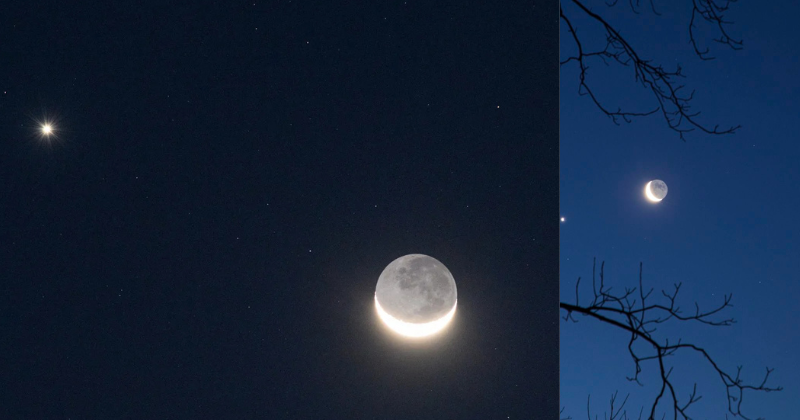
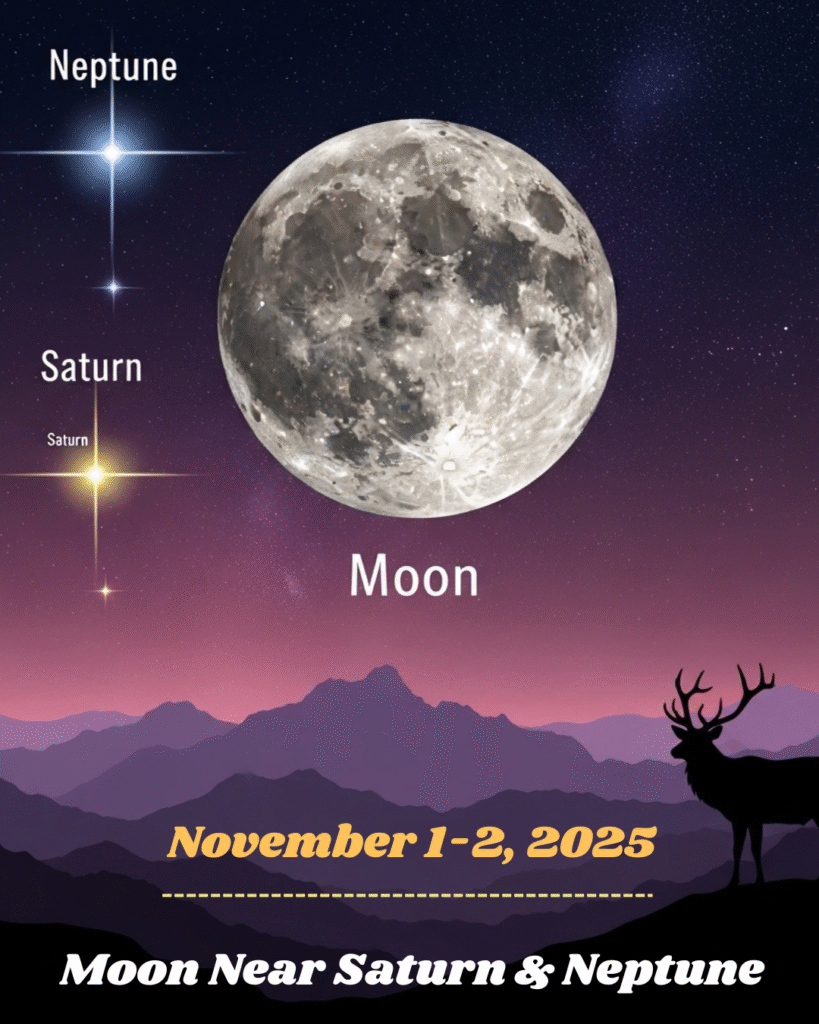
The night of November 1–2, 2025 offers a remarkable astronomical alignment as the Moon passes close to Saturn, creating a striking visual pairing visible to observers across the globe. This conjunction represents an excellent opportunity for both casual stargazers and dedicated amateur astronomers to witness planetary dynamics in action while exploring one of our solar system’s most magnificent worlds through binoculars or telescopes.
Understanding Planetary Conjunctions and Apparent Motion
Planetary conjunctions occur when two celestial bodies share similar celestial coordinates as viewed from Earth, appearing close together in our sky despite being separated by vast distances in space. The November 1–2 event brings the Moon—our natural satellite at approximately 384,400 kilometers distance—into visual proximity with Saturn, which lies roughly 1.4 billion kilometers from Earth. This apparent closeness results from the alignment of orbital planes and the relative positions of these bodies along the ecliptic, the apparent path the Sun traces across Earth’s sky throughout the year.
Saturn’s position in the constellation Aquarius during this period places it in a favorable viewing position during early evening hours. The Moon, in its waxing gibbous phase with approximately 70-80% of its visible surface illuminated, will shine brightly enough to serve as a convenient celestial signpost directing observers toward the ringed planet. The configuration allows viewers to locate Saturn more easily than during periods when it must be identified among countless background stars without such an obvious reference point.
Observational Parameters and Optimal Viewing Conditions
The conjunction reaches its closest apparent approach during the late evening hours of November 1, extending into the early morning of November 2. Observers in the Northern Hemisphere will find the pair positioned in the southern to southwestern sky after sunset, with the exact elevation depending on latitude. The angular separation between the Moon and Saturn during closest approach measures approximately 2 to 4 degrees—roughly the width of two to four fingers held at arm’s length against the sky.
For naked-eye observation, the event remains accessible from urban and suburban locations despite light pollution, though the lunar brightness may create some glare that reduces contrast. Saturn appears as a steady, yellowish point of light near the Moon, distinguishing itself from stars through its lack of twinkling—a characteristic resulting from its larger apparent disk size compared to point-source stars. The planet’s magnitude during this period hovers around +0.8, making it clearly visible but not as brilliant as Jupiter or Venus during their brightest phases.
Binocular observation transforms this casual viewing into a more engaging experience. Standard 7×50 or 10×50 binoculars reveal Saturn’s slightly oval shape, a consequence of the planet’s equatorial bulge and ring system appearing as a single elongated form at this magnification. The Moon’s craterous surface becomes dramatically apparent, with terminator shadows accentuating relief features along the boundary between illuminated and dark regions. The juxtaposition of these two objects within a single binocular field of view emphasizes the scale differences between a small, rocky satellite and a massive gas giant.
Telescopic Revelations and Saturnian System Details
Telescope users encounter the genuine spectacle of this conjunction. Even modest instruments with 60-80mm apertures and magnifications of 50-100x clearly resolve Saturn’s ring system as a separate structure encircling the planet’s disk. The rings, composed primarily of water ice particles ranging from micrometers to meters in size, currently present a viewing angle of approximately 3-4 degrees from edge-on as Saturn continues its gradual orbital progression. This relatively shallow tilt makes the rings less dramatic than during maximum inclination periods, but they remain distinctly visible and structurally detailed.
The Cassini Division—a 4,800-kilometer-wide gap between the A and B rings—becomes apparent in telescopes with 100mm aperture or larger under steady atmospheric conditions. This feature, discovered by Giovanni Domenico Cassini in 1675, results from orbital resonances with Saturn’s moon Mimas, which gravitationally clears particles from this particular region. Observers using 150mm or larger apertures under excellent seeing conditions may detect the fainter C ring, a translucent inner ring system appearing as a dusky band between the B ring and Saturn’s cloud tops.
Saturn’s atmospheric features present themselves with varying degrees of clarity depending on instrumental quality and atmospheric stability. The planet’s distinct banding structure reflects differential rotation rates at various latitudes, with equatorial zones completing rotations in approximately 10 hours and 14 minutes while polar regions require roughly 10 hours and 38 minutes. This variation creates visible shear patterns and color contrasts, though Saturn’s atmospheric features appear more subtle than Jupiter’s bold belts and zones. Experienced observers report occasional detection of white spots or storm systems, though these require larger apertures and exceptional conditions.
Satellite Observations and System Dynamics
Saturn’s extensive satellite system offers additional observational targets during this conjunction period. Titan, the largest Saturnian moon and second-largest satellite in our solar system, orbits at 1.2 million kilometers from Saturn and presents an eighth-magnitude disk easily visible in small telescopes. During the November 1–2 event, Titan’s position relative to Saturn may place it anywhere along its 16-day orbital path, potentially appearing east or west of the planet depending on precise timing.
The brighter mid-sized moons—Rhea, Tethys, Dione, and Iapetus—require slightly more attention to identify but remain accessible to observers using telescopes with 80mm or greater aperture. These satellites orbit within Saturn’s equatorial plane, creating a linear arrangement that mirrors the ring orientation. Careful observation over several hours reveals their orbital motion, with inner satellites like Enceladus completing their orbits in approximately 33 hours. This real-time observation of gravitational dynamics provides tangible evidence of Newtonian mechanics operating on cosmic scales.
Atmospheric Considerations and Timing Strategies
Atmospheric conditions significantly influence observational quality during any astronomical event. Temperature inversions, air turbulence, and moisture content affect « seeing »—the stability and sharpness of celestial images. The November 1–2 timeframe occurs during autumn in the Northern Hemisphere, when temperature differentials between day and night create more variable atmospheric conditions than summer months. Observers should allow Saturn and the Moon to reach at least 30 degrees elevation before serious telescopic observation, minimizing atmospheric thickness and turbulence encountered when viewing near the horizon.
Timing considerations extend beyond simple visibility windows. The Moon’s brightness creates scattered light that reduces contrast for nearby objects, including Saturn’s fainter moons and ring details. Observers seeking optimal Saturn views might consider beginning their session before the Moon rises or after it sets, though this approach sacrifices the aesthetic appeal of the conjunction itself. Alternatively, positioning Saturn at the edge of the telescope’s field of view while keeping the Moon outside the field reduces glare while maintaining the contextual relationship between the two bodies.
Photographic Documentation and Technical Approaches
The November 1–2 conjunction presents accessible photographic opportunities across various skill levels. Wide-field compositions capturing both Moon and Saturn require minimal equipment—a camera capable of manual exposure settings mounted on a stable tripod suffices for effective documentation. Exposure parameters typically range from 1/250 to 1/500 second at ISO 400-800 with apertures of f/4 to f/5.6, though exact settings depend on local light pollution and desired compositional elements. Including foreground landscape elements creates contextual interest while emphasizing the conjunction’s visibility from terrestrial vantage points.
Telescopic photography demands more specialized approaches. Lunar imaging through telescopes requires brief exposures—typically 1/100 to 1/500 second—to freeze details against atmospheric turbulence and prevent overexposure of the bright lunar surface. Saturn, being considerably dimmer, requires longer exposures or higher ISO settings, creating technical challenges when attempting to photograph both objects simultaneously. This exposure differential often necessitates separate imaging sessions or composite processing techniques combining differently exposed frames.
Advanced astrophotographers may employ lucky imaging techniques for Saturn, capturing hundreds or thousands of short-exposure video frames and selecting the sharpest examples for stacking and processing. This approach mitigates atmospheric turbulence effects, revealing finer detail in Saturn’s rings and atmospheric bands. The conjunction period’s inclusion of the Moon nearby allows photographers to create before-and-after comparison sequences showing the bodies’ relative motion over several hours, demonstrating the Moon’s rapid orbital progression of approximately 0.5 degrees per hour.
Historical Context and Observational Legacy
Conjunctions between the Moon and planets have held astronomical significance throughout human history. Ancient Babylonian astronomers recorded planetary positions relative to lunar phases, developing prediction methods that enabled calendar systems and agricultural planning. Greek astronomers including Hipparchus utilized lunar occultations—events where the Moon passes directly in front of planets or stars—to refine measurements of lunar orbital parameters and planetary distances.
The modern era’s precise ephemeris calculations allow prediction of conjunctions years in advance, yet the observational experience retains educational and aesthetic value. Each conjunction provides opportunities for public outreach, as the Moon’s familiar presence helps novice observers locate and identify planets they might otherwise overlook. The November 1–2 event occurs at convenient evening hours for family viewing, requiring no late-night sessions that might discourage participation by younger enthusiasts.
Educational Applications and Scientific Literacy
Observing planetary conjunctions develops practical understanding of celestial mechanics and spatial relationships. The apparent motion of the Moon relative to background stars and planets illustrates orbital dynamics in observable real-time, transforming abstract concepts into concrete experiences. Measuring angular separations using simple tools—fingers at arm’s length, binocular field of view estimates, or calibrated eyepiece reticles—introduces fundamental astronomical measurement techniques without requiring sophisticated equipment.
The contrast between the Moon’s nearby, rapidly moving presence and Saturn’s distant, nearly stationary position over single nights demonstrates the scale hierarchies governing our solar system. The Moon, orbiting Earth at a distance requiring light travel time of just 1.28 seconds, shifts noticeably against background objects over hours. Saturn, at a light travel time of approximately 80 minutes during this period, shows no perceptible motion from night to night without careful position recording. These observations reinforce concepts of distance, orbital velocity, and perspective that underpin modern astronomy.
Extending the Observational Experience
The November 1–2 conjunction represents a single point in an ongoing sequence of celestial events. Saturn remains visible throughout autumn and early winter 2025, gradually shifting westward in the evening sky as Earth’s orbital motion carries our planet around the Sun. Dedicated observers can track Saturn’s retrograde motion—apparent westward drift against background stars—that occurred earlier in 2025, followed by direct motion resuming as Earth’s faster orbital velocity carries us past Saturn’s position.
Subsequent lunar conjunctions with Saturn occur approximately every 27.3 days, corresponding to the Moon’s sidereal orbital period. Each conjunction presents slightly different configurations, viewing angles, and separation distances as the Moon’s orbital plane precesses relative to the ecliptic. Tracking these recurring events throughout the year reveals the rhythmic pattern of lunar and planetary motions while providing regular opportunities for observation and photography.
The night sky of November 1–2, 2025 offers more than a simple alignment of celestial bodies. This conjunction provides a gateway to exploring planetary characteristics, orbital mechanics, and observational astronomy techniques accessible to anyone willing to look upward after sunset. The event requires no specialized knowledge or expensive equipment for meaningful participation, yet rewards careful observation with insights into the dynamic universe surrounding our planet.