
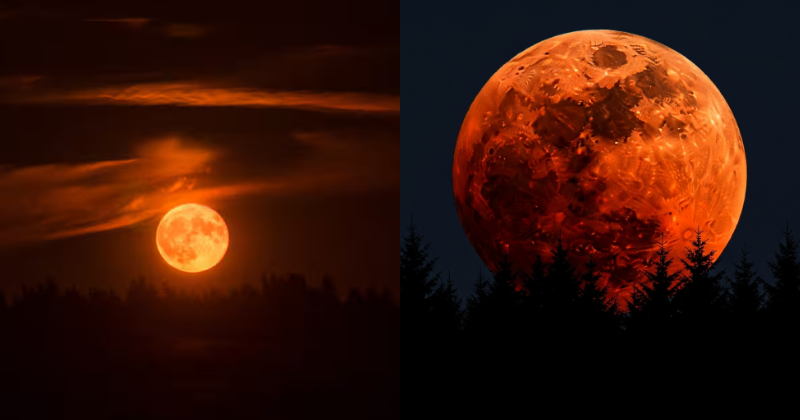
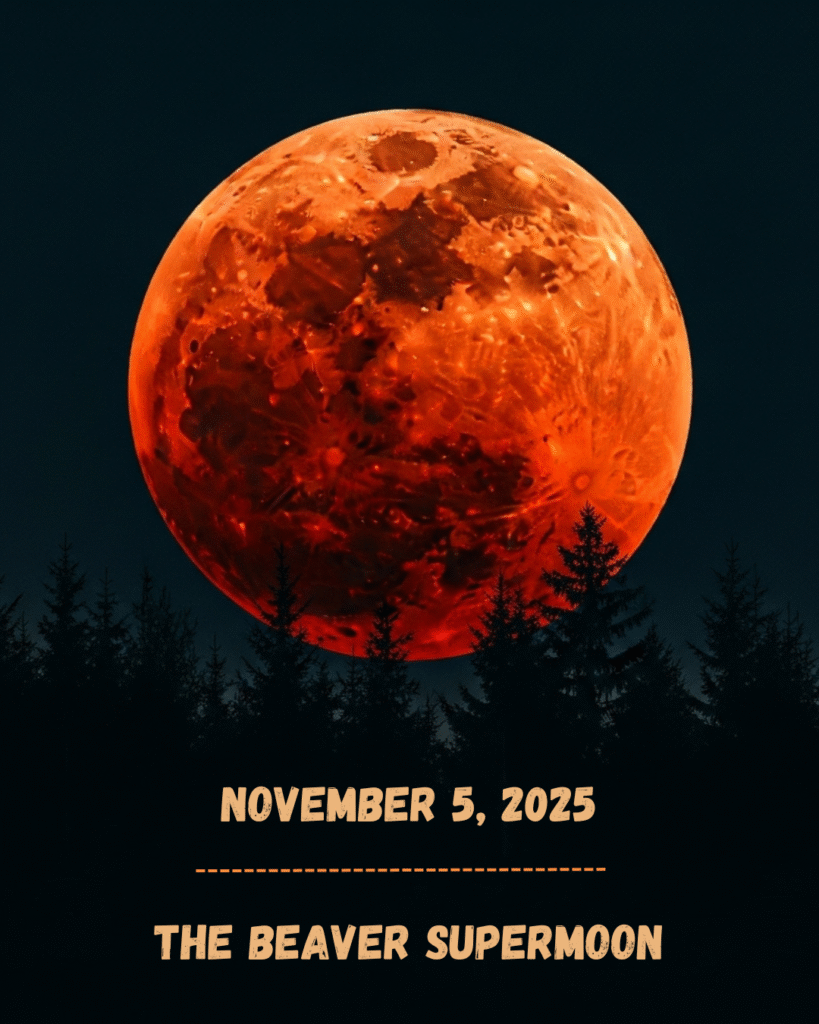
The Beaver Supermoon of November 2025 offers stargazers a spectacular celestial display, appearing up to 14% larger and 30% brighter than a typical full moon as Earth’s natural satellite reaches its closest orbital point.
Understanding the Beaver Supermoon Phenomenon
A supermoon occurs when the full moon coincides with perigee, the point in the Moon’s elliptical orbit where it comes closest to Earth. During November 2025, this astronomical alignment creates what observers call the Beaver Supermoon, named after the traditional period when beavers complete their winter preparations and trappers historically set beaver traps before waterways froze.
The Moon’s orbit around Earth follows an elliptical path rather than a perfect circle, with distances varying between approximately 356,500 kilometers at perigee and 406,700 kilometers at apogee. This 50,000-kilometer difference produces noticeable variations in the Moon’s apparent size and luminosity. During a supermoon event, the proximity enhancement creates a visually striking display that captures both scientific interest and public imagination.
Orbital Mechanics and Timing Considerations
The November 2025 Beaver Supermoon results from precise gravitational dynamics between Earth, Moon, and Sun. The lunar cycle of 29.5 days occasionally synchronizes with the Moon’s perigee cycle of 27.3 days, producing these enhanced full moon events roughly three to four times annually.
Astronomers measure the Moon’s distance using laser ranging techniques, bouncing light off reflectors placed on the lunar surface during Apollo missions. These measurements reveal that the Moon’s orbit experiences subtle perturbations from solar gravity, planetary influences, and tidal forces. The timing of perigee shifts gradually throughout the year, making each supermoon event unique in its specific distance and brightness characteristics.
For November 2025, the full moon phase occurs within hours of perigee passage, maximizing the visual impact. Observers will notice the enhanced brightness particularly during moonrise and moonset, when atmospheric refraction and the Moon illusion combine with the genuine size increase to create an especially dramatic appearance.
Observational Strategies and Optimal Viewing Conditions
The Beaver Supermoon reaches peak illumination during the evening hours across North America and Europe, with visibility extending globally as Earth rotates. Unlike solar eclipses or meteor showers requiring specific timing windows, a full moon remains prominently visible throughout the night, offering flexible observation opportunities.
For optimal viewing, seek locations with unobstructed eastern horizons during moonrise. The Moon appears most impressive when positioned near the horizon, where comparison with terrestrial features like buildings, trees, or mountains enhances the perception of size. This psychological effect, known as the Moon illusion, amplifies the already genuine size increase of the supermoon.
Photography enthusiasts should prepare equipment several hours before peak illumination. A telephoto lens with focal lengths between 200mm and 400mm captures lunar details effectively while maintaining manageable exposure settings. The supermoon’s enhanced brightness requires shorter exposure times than typical lunar photography, typically around 1/250 second at ISO 200 with an aperture of f/8 to f/11.
Urban observers contending with light pollution can still appreciate the supermoon’s brightness and size, though traveling to darker locations reveals subtle color variations in the lunar maria and highlands. Binoculars or small telescopes magnify surface features, transforming the observation from a general spectacle into detailed exploration of impact craters, mountain ranges, and ancient volcanic plains.
Cultural Significance and Historical Context
Indigenous peoples across North America developed lunar calendars reflecting seasonal cycles and ecological patterns. The Beaver Moon designation originates from Algonquin traditions, marking the optimal period for trapping beavers whose thick winter pelts reached prime quality. Alternative names from other cultures include the Frost Moon, highlighting the advancing cold season, and the Mourning Moon in certain regional traditions.
European settlers adopted and adapted these Indigenous naming conventions, creating a cultural bridge through shared observation of celestial events. The widespread recognition of these traditional moon names demonstrates how astronomical phenomena transcend cultural boundaries, connecting human societies through common experiences of the natural world.
Modern celebrations of supermoons blend scientific understanding with cultural appreciation. Communities organize viewing events, educational programs explore lunar science, and social media platforms fill with photographs capturing the enhanced lunar display. This contemporary engagement continues humanity’s ancient tradition of marking significant celestial events while incorporating modern technological capabilities for observation and documentation.
Scientific Research Opportunities
Supermoon events provide valuable opportunities for lunar science research beyond their aesthetic appeal. The Moon’s proximity during perigee enhances the precision of laser ranging measurements, contributing to studies of lunar orbit evolution, gravitational interactions, and relativistic effects predicted by Einstein’s general relativity.
Tidal forces increase during supermoon periods, with ocean tides reaching slightly higher peaks than typical full moon tides. Coastal researchers monitor these enhanced tidal ranges to study sediment transport, coastal erosion patterns, and ecological impacts on intertidal zones. The difference amounts to only a few centimeters beyond normal spring tides, but accumulated effects over repeated supermoon cycles contribute measurably to coastal dynamics.
Amateur astronomers contribute to scientific understanding through systematic observation and photography. Coordinated imaging campaigns during supermoons help refine models of lunar libration, the subtle wobbling motion that reveals slightly different lunar surface areas over time. These collaborative efforts demonstrate how public engagement with astronomical events extends beyond passive observation into active scientific participation.
Atmospheric and Environmental Factors
Weather conditions significantly influence supermoon visibility, with clear skies essential for optimal observation. November typically brings variable weather across temperate latitudes, with some regions experiencing stable high-pressure systems while others face approaching winter storms. Checking local weather forecasts several days in advance helps plan observation strategies and identify backup viewing dates if clouds obstruct the peak night.
Atmospheric transparency affects lunar color and clarity. Clean, dry air produces crisp, white-gold lunar appearances, while humid or dusty conditions can impart amber or reddish tones through selective scattering of shorter wavelengths. These atmospheric effects add character to supermoon observations, creating unique visual experiences even when slightly diminishing technical image quality.
Temperature considerations matter for extended outdoor viewing sessions in November. Northern regions may experience freezing conditions requiring appropriate clothing, while southern latitudes offer more comfortable observation temperatures. Planning for thermal comfort ensures sustained observation opportunities without discomfort forcing premature retreat indoors.
Photographic Documentation Techniques
Capturing the Beaver Supermoon’s magnificence requires balancing technical precision with artistic vision. The Moon’s enhanced brightness during supermoon events actually simplifies exposure calculations compared to typical lunar photography, allowing faster shutter speeds that freeze atmospheric turbulence and reduce camera shake.
Composition strategies vary based on artistic goals. Wide-angle shots incorporating foreground landscape elements tell stories about place and context, connecting the celestial event with terrestrial settings. Telephoto images isolate the lunar disk, revealing surface details and subtle color variations across different geological regions.
Time-lapse sequences document the Moon’s apparent motion across the sky, creating dynamic visual narratives of the night’s progression. Interval timing between 30 seconds and two minutes produces smooth motion while maintaining reasonable file sizes. These sequences effectively illustrate the Moon’s path relative to stars, demonstrating Earth’s rotation through changing celestial perspectives.
Post-processing enhances lunar photographs without compromising authenticity. Moderate contrast adjustments reveal crater details in shadow regions while preserving highlight information in brightly lit areas. Color balance corrections compensate for atmospheric tinting while maintaining natural-looking results that accurately represent the visual experience.
Comparative Analysis with Other Lunar Events
The November 2025 Beaver Supermoon represents one event within the broader context of lunar cycles and celestial phenomena. Comparing supermoons with micromoons, when the full moon coincides with apogee, reveals the full range of apparent size variation observable from Earth. The difference between extreme cases reaches approximately 14%, though casual observers typically notice variations only during direct comparison.
Supermoons differ fundamentally from lunar eclipses, which require precise three-body alignment between Sun, Earth, and Moon. While supermoons occur several times annually, total lunar eclipses happen less frequently and demand specific geometric conditions. Both phenomena generate public interest, though eclipses generally attract more attention due to their dramatic color changes and relative rarity.
Seasonal variations affect observational experiences of supermoons occurring at different times throughout the year. Summer supermoons remain relatively low in the sky for northern observers, appearing warmer in tone due to increased atmospheric path length. Winter supermoons like the Beaver Moon climb higher overhead, appearing more brilliant and white against darker skies with longer night durations supporting extended observation periods.
Educational Outreach and Public Engagement
The Beaver Supermoon presents valuable educational opportunities for astronomy outreach programs. Schools, planetariums, and astronomical societies organize viewing events that introduce fundamental concepts about lunar motion, orbital mechanics, and observational techniques. These programs leverage public interest in spectacular celestial events to build broader understanding of astronomical science.
Interactive demonstrations using scale models help audiences visualize the Earth-Moon system and understand how elliptical orbits produce supermoon phenomena. These hands-on activities make abstract concepts concrete, particularly effective for younger learners developing spatial reasoning abilities. Combining physical models with actual telescopic observation creates memorable educational experiences that inspire continued interest in astronomy.
Digital resources extend educational reach beyond local communities. Live-streamed observations allow global audiences to experience the supermoon simultaneously, while recorded presentations remain available for later viewing. Social media platforms facilitate sharing of photographs and observations, creating virtual communities united by shared appreciation of celestial events.
Future Supermoon Predictions and Long-Term Patterns
Astronomical calculations allow precise prediction of future supermoon events extending decades ahead. The November 2025 Beaver Supermoon forms part of recurring patterns as the lunar orbit cycle gradually shifts relative to calendar months. Understanding these patterns helps observers anticipate upcoming events and plan observation campaigns.
The frequency and intensity of supermoons vary gradually over multi-year cycles as the Moon’s orbit precesses and evolves. Some years feature four supermoons while others present only two or three. Tracking these variations provides insights into long-term gravitational dynamics affecting the Earth-Moon system.
Secular changes in the Moon’s orbit, though occurring over timescales of millions of years, gradually modify the nature of supermoon events. The Moon recedes from Earth at approximately 3.8 centimeters annually due to tidal dissipation, meaning ancient supermoons appeared even more impressive than contemporary events. Future observers millions of years hence will see diminished supermoon effects as the Moon continues its gradual orbital expansion.
The Beaver Supermoon of November 2025 offers more than visual splendor. It represents a convergence of orbital mechanics, cultural tradition, and observational opportunity that connects contemporary viewers with thousands of years of human fascination with Earth’s celestial companion.