

Painting tree trunks white is a common horticultural practice that protects trees from sunscald, temperature fluctuations, and pest damage while extending their productive lifespan and maintaining structural integrity.
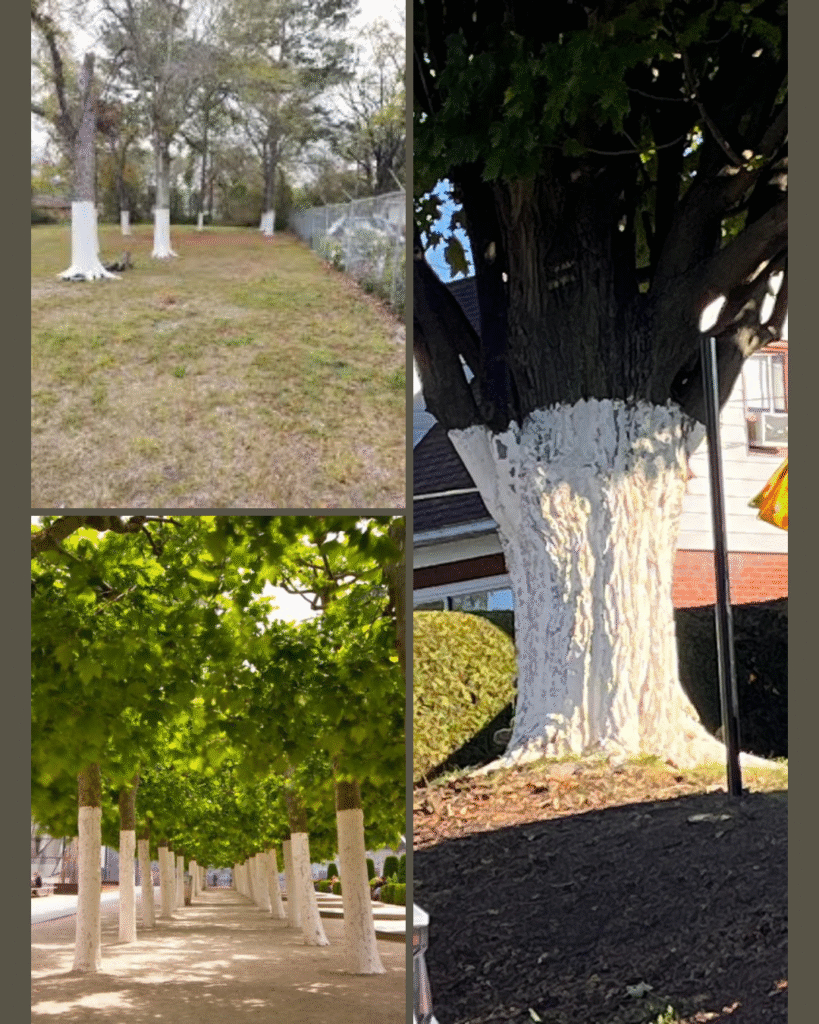
Walk through any orchard or urban park in late autumn, and you’ll likely encounter rows of trees with their lower trunks painted brilliant white. This practice, known as whitewashing or trunk painting, has been used for centuries across different cultures and climates. While it might appear purely decorative, this tradition serves multiple practical purposes rooted in plant physiology and environmental protection.
The Science Behind Whitewashing: Solar Radiation Management
The primary function of white trunk paint relates to albedo—the measure of how much light a surface reflects. Dark bark naturally absorbs significant amounts of solar radiation, particularly during winter months when the sun sits lower on the horizon and strikes tree trunks at more direct angles.
When bark absorbs sunlight on cold winter days, the temperature of the trunk’s south and southwest sides can rise dramatically, sometimes reaching 15-20°C above ambient air temperature. As evening approaches and temperatures plummet, this rapid cooling creates thermal stress within the cambium layer—the thin tissue responsible for nutrient transport and growth. These extreme temperature swings cause the bark to crack and split, creating wounds that invite disease and pest colonization.
White paint reflects up to 70-90% of incoming solar radiation, maintaining more stable trunk temperatures throughout daily cycles. This reflection prevents the damaging freeze-thaw cycles that compromise tree health during vulnerable winter months.
Sunscald and Frost Crack Prevention
Sunscald represents one of the most common forms of environmental damage affecting young and thin-barked trees. The condition occurs when warm winter sunshine activates metabolic processes in the cambium during daylight hours, followed by rapid tissue freezing after sunset. Repeated exposure creates necrotic lesions that appear as discolored, sunken patches on the bark surface.
Young fruit trees—particularly apple, cherry, peach, and citrus varieties—demonstrate high susceptibility to sunscald damage. These trees often lack the thick, protective bark that mature specimens develop. The southwest side of trunks experiences the greatest exposure in the Northern Hemisphere, where afternoon sun combines with reflected snow glare to intensify radiation effects.
Whitewashing creates a protective barrier that moderates these temperature extremes. Studies conducted in commercial orchards have documented 60-80% reductions in sunscald incidence among whitewashed trees compared to untreated controls. The practice proves particularly valuable during the first 3-5 years after transplanting, when young trees establish root systems and lack mature protective bark.
Chemical Composition and Application Methods
Traditional whitewash formulations combine slaked lime (calcium hydroxide) with water, creating an alkaline solution with pH values around 12-13. Modern formulations often incorporate additional components: white latex paint provides improved adhesion and weather resistance, while clay adds binding properties. Some commercial products include copper sulfate or other fungicides that offer supplemental disease protection.
The typical application ratio combines one part hydrated lime with one part water, though variations exist based on climate and tree species. Adding 5-10% white latex paint extends durability without compromising reflective properties. Application occurs during late autumn or early winter, before the onset of severe cold but after trees enter dormancy.
Proper application extends from ground level to approximately 60-90 centimeters up the trunk, covering the zone most vulnerable to direct sun exposure. Some practitioners paint higher on young trees or extend coverage to lower scaffold branches. The coating should be thick enough to obscure bark color but not so heavy that it forms drips or clumps.
Pest and Disease Management Functions
Beyond temperature regulation, whitewash formulations provide secondary protective benefits against biological threats. The alkaline pH of lime-based solutions creates an inhospitable environment for fungal spores, bacterial pathogens, and overwintering insect eggs that might otherwise colonize bark crevices.
Many borers, beetles, and other wood-boring insects select host trees partly through visual cues. The altered appearance of whitewashed trunks can disrupt this recognition, reducing oviposition rates. Some evidence suggests that certain insects avoid the bright white surface, though this effect varies among species and remains less pronounced than the thermal protection benefits.
The antimicrobial properties of hydrated lime offer modest protection against fungal diseases like black rot, fire blight, and various canker-causing organisms. While whitewashing cannot substitute for proper disease management protocols, it contributes to overall tree health as part of integrated pest management approaches.
Historical and Cultural Perspectives
The practice of painting tree trunks appears across diverse agricultural traditions. Mediterranean orchards have employed lime whitewashing for millennia, with references appearing in ancient Roman agricultural texts. In traditional Chinese horticulture, whitewashing served both practical and aesthetic purposes, particularly in formal gardens where uniformly painted trunks created visual harmony.
European colonists transported the practice to the Americas, where it became standard in commercial fruit production. Soviet agricultural programs promoted systematic whitewashing across collective farms, establishing it as a defining feature of Eastern European orchards. Even today, the sight of white-painted tree trunks evokes strong cultural associations with organized agricultural landscapes.
In urban environments, whitewashing has experienced periodic revivals. Municipal forestry programs sometimes employ the technique to protect newly planted street trees during establishment periods. The visual impact—rows of white-trunked trees lining boulevards—creates distinctive seasonal landscapes in cities that maintain this tradition.
Species-Specific Considerations and Limitations
Not all tree species benefit equally from trunk painting. Thin-barked species like maple, cherry, apple, and young citrus trees gain substantial protection. Conversely, trees with naturally thick, corky bark—such as mature oaks or conifers like pines—possess inherent insulation and require whitewashing only in exceptional circumstances.
Tropical and subtropical species rarely need whitewashing unless transplanted to regions with significant winter temperature fluctuations. However, even in warm climates, newly transplanted trees with sun-sensitive bark may benefit from temporary protection during the establishment phase.
The practice carries minimal risks when properly executed. Excessively thick applications can potentially trap moisture against bark surfaces, creating conditions favorable for fungal growth. Using inappropriate materials—such as oil-based paints that prevent gas exchange—can damage living tissues. These concerns are largely avoided by using appropriate lime-based or water-based latex formulations applied in thin, even coats.
Modern Alternatives and Innovations
Contemporary horticulture offers various alternatives to traditional whitewash. Commercial tree wraps made from paper, burlap, or specialized fabric provide physical shielding from sun exposure. These materials excel at protecting individual trees but prove labor-intensive for large-scale orchards.
Reflective trunk guards constructed from corrugated plastic or cardboard offer reusable protection. While effective, they require installation and removal, potentially harboring pests if left in place during growing seasons.
Some researchers have explored photoreactive coatings that respond dynamically to temperature changes, though these remain largely experimental. Kaolin clay sprays, originally developed for insect management, provide similar reflective benefits and have gained acceptance in organic fruit production.
Despite modern innovations, traditional whitewashing persists due to its simplicity, effectiveness, and low cost. A single application typically lasts an entire dormant season, requiring reapplication only annually or biannually.
Practical Implementation Guidelines
Successful whitewashing requires attention to timing and technique. Applications should occur during dry weather when temperatures remain above freezing, allowing proper adhesion and curing. Avoid painting during active growth periods or when temperatures exceed 25-27°C, as this may cause unnecessary stress.
Clean loose bark and debris from trunk surfaces before application, ensuring paint contacts living tissue rather than dead material. Use brushes or sprayers appropriate to the scale of operation—hand brushes for individual garden trees, backpack sprayers for small orchards, motorized equipment for commercial operations.
For young trees, begin whitewashing immediately after transplanting or during the first dormant season. Maintain annual applications until bark thickens sufficiently—typically 5-7 years for most fruit trees. Mature trees with established bark may not require continued treatment unless showing signs of sunscald or experiencing unusual environmental stress.
The practice represents a simple yet effective intervention that aligns with both traditional wisdom and modern horticultural science. Whether managing a backyard orchard or simply protecting a recently planted ornamental tree, whitewashing offers proven protection that has endured through generations of practical application.